3 June 2026
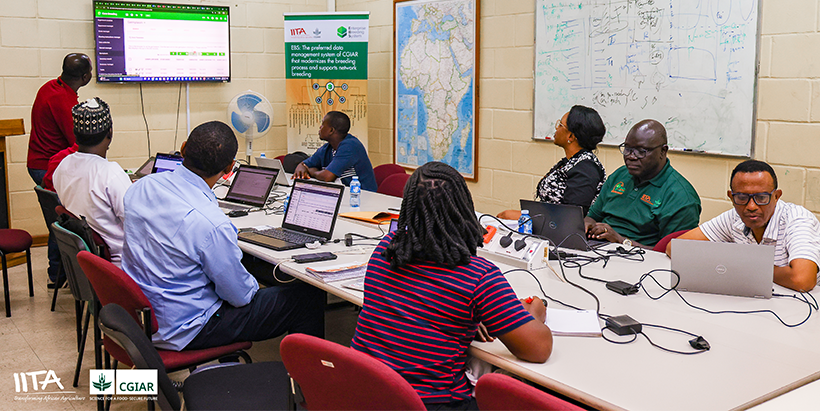 Hands-on session during the EBS and Bioflow training at IITA, Ibadan.
Efforts to modernize breeding operations across CGIAR centers and partner institutions, rooted in a broader shift toward data-driven, digitally enabled breeding systems, received renewed momentum as researchers, breeders, data managers, and technical teams gathered at IITA Headquarters on the 19-21 May, for a training workshop on the Enterprise Breeding System (EBS) Core Breeding application and Bioflow application.
The training focused on improving how data is captured, managed, shared, analysed and used within the IITA and CGIAR breeding programs, thereby supporting more efficient and integrated breeding operations.
Developed under the CGIAR Excellence in Breeding initiative, the Enterprise Breeding System (EBS) is an open-source, end-to-end breeding informatics platform designed to integrate the various stages of the breeding pipeline, from germplasm management and trial design to data capture, analysis, and decision-making—within a single, unified system while supporting modern breeding workflows.
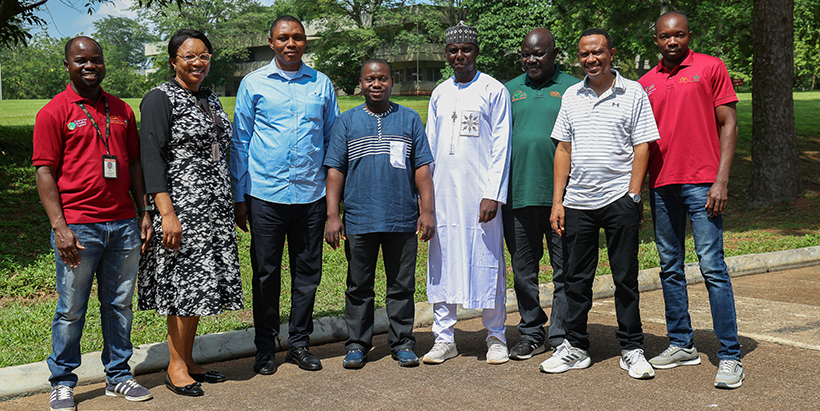 Cross section of the training participants.
The workshop provided participants with practical sessions on the core functionalities of EBS and Bioflow, including consolidation of diverse datasets, experiment creation and management, germplasm tracking, data collection, data uploads, data analysis and information sharing across breeding teams, enabling breeders to improve accuracy and efficiency while significantly reducing the time and complexity associated with data management.
Participants also explored recent upgrades aimed at improving workflow efficiency and real-time accessibility of breeding information.
A major highlight of the engagement was the emphasis on harmonizing breeding operations and reducing the challenges associated with fragmented or inconsistent data management systems. By integrating breeding activities within a shared digital platform, EBS is helping institutions strengthen data quality, standardization, and accessibility while enhancing collaboration among breeding networks.
IITA Data Manager for Breeding, Simon Imoro, described EBS as an integrated workflow that connects breeding operations from nursery creation and experiment design to field data collection, analysis, and variety release within a single platform. He explained that the platform was developed to help breeding programs function more efficiently through improved data management and integrated digital processes.
Also, IITA Maize Unit Research Administrative Manager, Bunmi Bossey, highlighted nursery management, breeding crosses, and hybrid formation as key strengths of the platform. She explained that the improved functionality in EBS will help scale breeding activities, support product development, and improve management processes from planting through harvest.
At its core, the EBS Core Breeding application supports critical workflows such as crossing, nursery advancement, and multi-location trials, while seamlessly integrating with analytical tools that enable genomic prediction and advanced statistical modeling. This integration is particularly important as modern breeding increasingly relies on large and complex datasets, precision tools, and predictive analytics to accelerate genetic gain—the rate at which improved varieties are developed and delivered to farmers.
Crucially, the adoption of EBS and Bioflow has far-reaching implications for agricultural impact. By improving data quality, enhancing decision accuracy, and shortening breeding cycles, the platform enables the faster development of climate-resilient, high-yielding, and nutrient-rich crop varieties tailored to farmers’ needs, particularly in Africa, Asia, and Latin America.
In a context where breeding programs must respond to climate change, evolving pests and diseases, and growing food demand, such digital transformation is essential for translating research investments into tangible outcomes in farmers’ fields.
As adoption of the Enterprise Breeding System expands across breeding programs, the platform is expected to strengthen collaborative research, streamline breeding workflows, and support the delivery of improved maize varieties that better meet farmers’ needs across Africa and beyond.




 Topics
 Species