St. Louis, Missouri, USA
April 21, 2026
New research combines no-till, cover crops, and precision nitrogen with drone and field data to reduce costly grain-quality testing and guide smarter management decisions.
As growers face tighter margins and more volatile weather, regenerative agriculture is increasingly viewed as a pathway to improve soil health while keeping farms profitable. A new peer-reviewed study from the Danforth Center demonstrates how pairing regenerative practices—no-till, winter cover cropping, and precision nitrogen management—with advanced analytics can accelerate the evaluation of grain traits and performance, supporting faster, data-driven decisions for breeders and growers in sorghum, a climate-resilient crop used for food, feed, and bioenergy.
Published recently in Frontiers in Plant Science, the study, “Modeling grain biochemical composition traits of commercial sorghum hybrids under diverse management practices,” evaluated two commercial sorghum hybrids across integrated management combinations at the Danforth Field Research Site in St. Charles, Missouri. Researchers in the lab of Principal Investigator Nadia Shakoor, PhD, assistant member, combined field-based physiological measurements with UAV (drone) imagery and management data to model key grain-quality traits, including protein, starch, amylose, lysine, and crude fat.
A major outcome: the team demonstrated a pathway to reduce the number of expensive lab assays needed to measure grain composition while still retaining strong predictive power. This could lower analysis costs in large breeding trials and commercial testing workflows, helping accelerate the adoption of management strategies that support both sustainability and profitability.
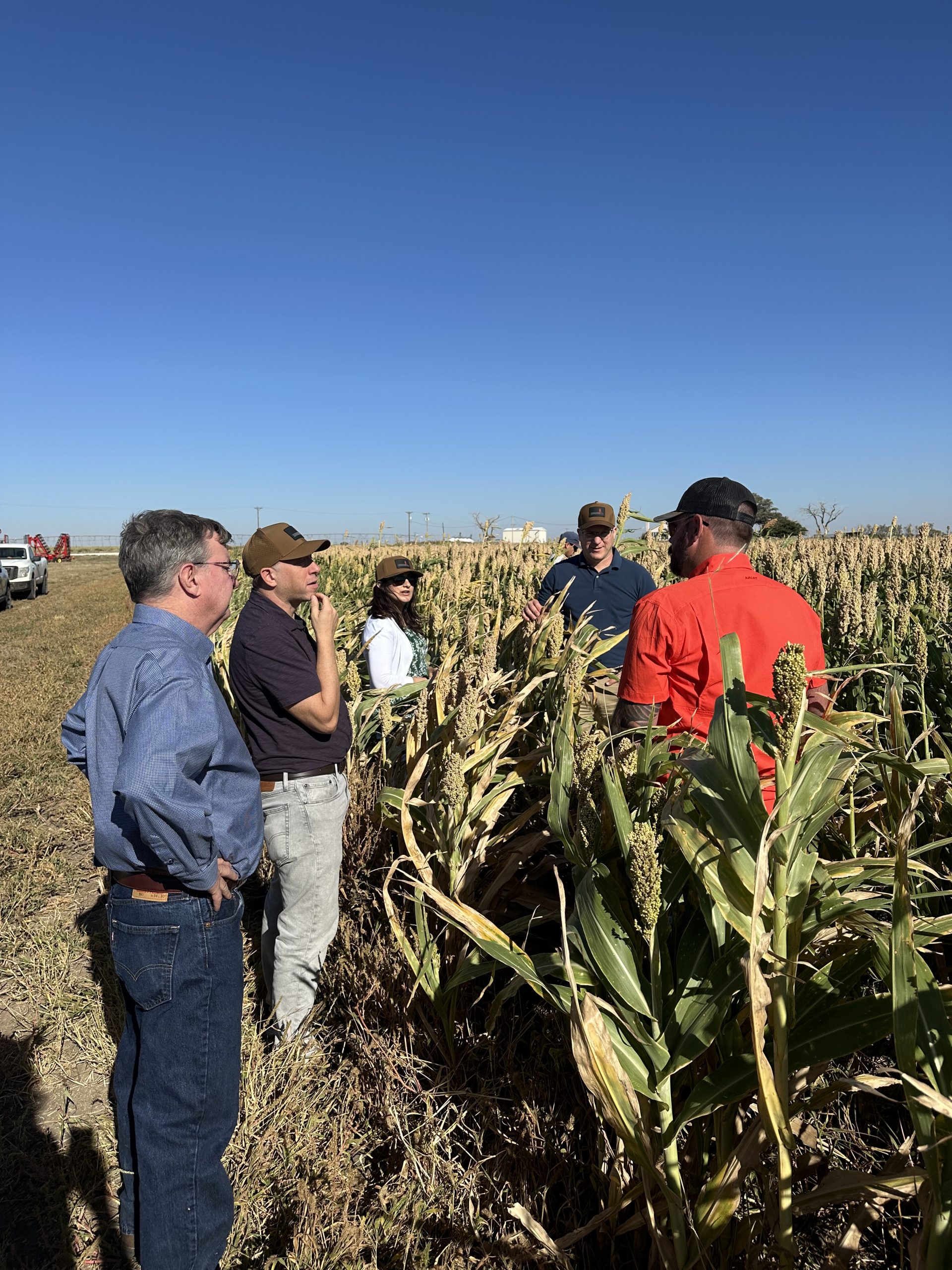 Dr. Nadia Shakoor (center) with farmers from the National Sorghum Producers in Texas.
“Regenerative agriculture has to work on the ground for farmers—economically and agronomically,” said Giles Oldroyd, president of the Danforth Center. “This research shows what’s possible when we combine practical conservation practices like no-till and cover crops with modern data science. The goal is to help farmers make regenerative decisions that make financial sense—using better information, fewer inputs where possible, and tools that scale.”
The study highlights that outcomes can depend on the hybrid and the environment, underscoring the importance of tailoring regenerative management to specific genetics and local conditions. By integrating data streams across seasons, the team’s approach supports a future where growers and breeders can identify which combinations of hybrid + management best optimize yield, grain quality, and resilience.
“Sorghum growers are already leaders in resilience and efficiency,” said National Sorghum Producers Chair Amy France, a farmer from Scott City, Kansas. “This research connects regenerative practices with real-world profitability, giving growers clearer data and greater confidence to adopt conservation strategies that strengthen both their soil and their bottom line.”
The work was conducted at the Danforth Field Research Site as part of a broader multi-year sorghum effort supported by the National Sorghum Producers, with related research across the program informed by producer engagement. The researchers note that data-driven tools, especially when paired with field validation, can improve efficiency across breeding and production systems and help advance climate-resilient agriculture at scale.
Citation
Gano, B., de Gracia Coquerel, M., Saxton, J., Eck, N., Peiris, K. H. S., Bean, S. R., Stanton, J., Ahmed, N., & Shakoor, N. (2026). Modeling grain biochemical composition traits of commercial sorghum hybrids under diverse management practices. Frontiers in Plant Science, 17, 1768456. https://doi.org/10.3389/fpls.2026.1768456




 Topics
 Species