United KIngdom
September 23, 2025
Across the biosciences, spatial transcriptomics is transforming our understanding of living systems, bringing spatial resolution to cellular genomics and reshaping fields from medicine and biotechnology to developmental biology.
Unlike traditional single-cell studies that require the dissociation of cells and tissue - resulting in the loss of important contextual information - spatial transcriptomics preserves tissue architecture. By measuring gene expression in situ, scientists can better understand differences in gene expression, identify cell-to-cell interactions, and visualise spatial organisation.
The new system builds on the Institute’s existing spatial transcriptomic infrastructure, enhancing Earlham Institute’s ability to address fundamental questions in cellular behaviour.
The Vizgen MERSCOPE UltraTM uses the MERFISH (Multiplexed Error Robust Fluorescence In Situ Hydridisation) technology, with two flow cell sizes - 1.25cm2 and 3cm2 - allowing for larger tissues or more replicates, to fit onto a single slide per run.
The Earlham Institute was an early adopter of this technology. Since the installation of the first Vizgen MERSCOPE platform in 2023, scientists have developed significant expertise in applying these techniques in both mammalian and plant systems, notably collaborating with researchers to spatially resolve 200 genes in developing wheat spikelets.
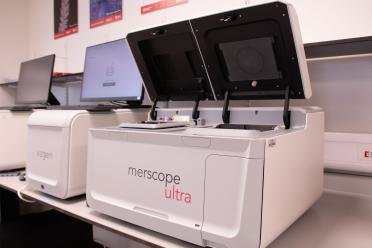
Dr Iain Macaulay, Technical Development Group Leader at the Earlham Institute, said: “This award will not only scale up our capacity to undertake spatial science, but is also a testament to the hard work of the team over the last two years in developing expertise that can support cutting-edge research across both model and non-model systems.”
Ashleigh Lister, Senior Research Assistant in the Macaulay Group said: “This is an incredibly exciting field of study and our expertise builds on nearly 10 years of single-cell and spatial science at the Earlham Institute.”
Ashleigh and Platform Manager Andrew Goldson, co-leads on the award, have been instrumental in developing and optimising the platform. In May 2024 the team led the UK’s first plant spatial transcriptomics workshop.
“The expansion of our capacity will enable us to continue this innovative research and collaborative service provision, as well as scaling up our training provision to the wider community,” Ashleigh added.
In early 2025 the Earlham Institute became one of the first Certified Service Providers (CSP) for Vizgen spatial transcriptomics worldwide, and the only CSP in the UK.
Through the BBSRC-funded National Bioscience Research Infrastructure (NBRI) in Transformative Genomics, the Institute supports the UK science community with world-class single-cell and spatial infrastructure, underpinned by a team of expert researchers.
If you are interested in working with us, please email us or read more about the platform.




 Topics
 Species