United Kingdom
March 3, 2025
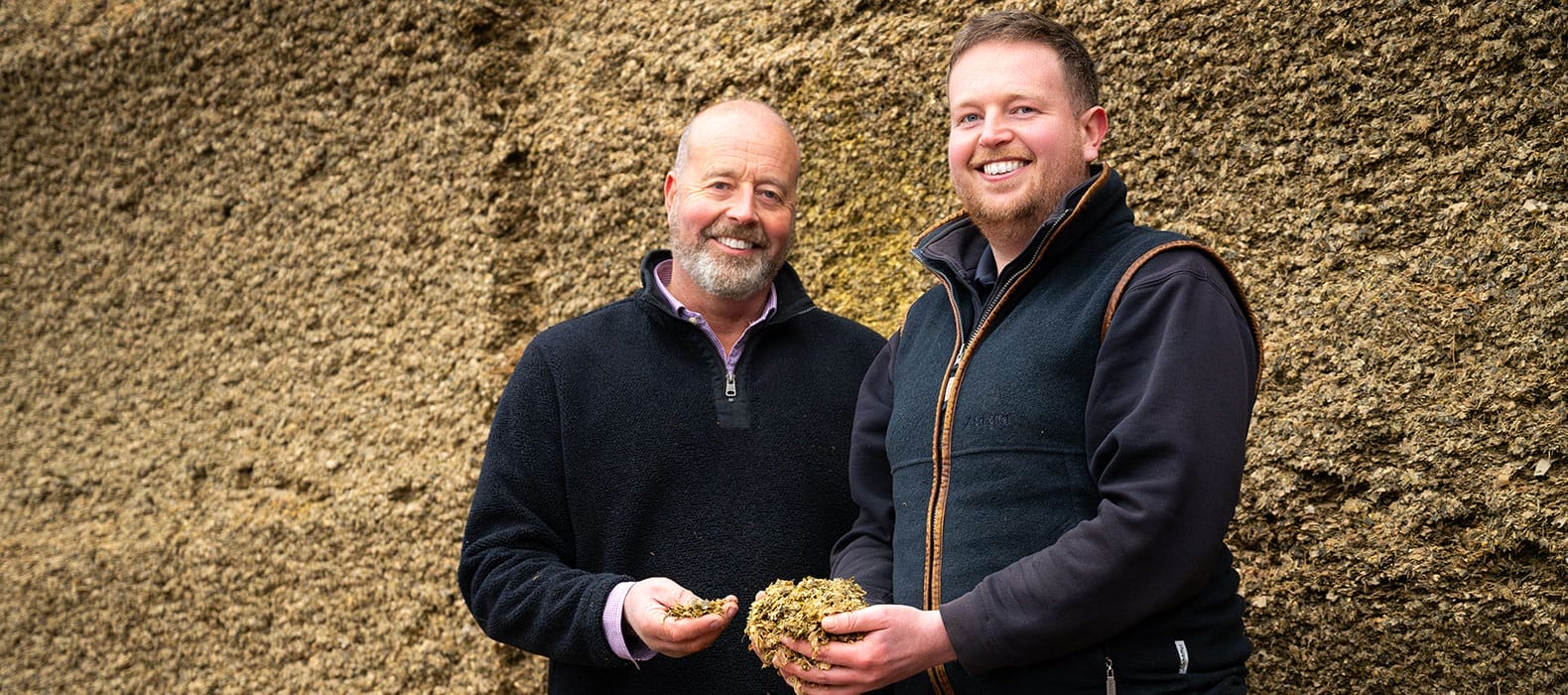
For North Wales mixed farmers Neal Morris and his son George, maize is an important forage for their milk production and beef finishing enterprises. It is also an integral part of their wider farming system, playing a key role as a break crop in their arable rotation.
The important point for Neal and George is that all enterprises are complementary to one another, with nothing done to the detriment of anything else. For that reason, they are constantly evolving their maize growing strategy, with earlier maturing varieties an essential element going forward.

Neal Morris (right) and son, George, run a mixed dairy, beef, sheep and arable business at New Sontley Farm in North Wales.
“We aim to create a balance in everything we do,” Neal says. “With maize, we are looking for consistency, rather than necessarily pushing for the highest yields, and it’s vital that we’ve harvested a mature crop in time to plant winter wheat.
“After the very challenging conditions we encountered in 2023, we’ve done things a little differently in 2024. Instead of growing a single variety, we’ve looked at several different options, including the very early maturing Duke. This has delivered exactly what we’d hoped, in terms of starch and dry matter, but most importantly it produced fully ripe cobs well before the end of September.”
New Sontley Farm, near Wrexham, runs the large, high-yielding Erddig herd of pedigree Holstein Friesian milking cows on a conventional winter housed and summer grazed system. With sexed semen used to optimise the production of replacement heifers, crossbred calves are retained and go into the farm’s beef finishing system. In addition to a substantial arable acreage, the farm also runs a flock of breeding sheep.

350 acres of maize are grown in rotation following either barley, Italian ryegrass or stubble turnips.
The ground is predominantly of a medium loam type, with some heavier land. Maize has been grown since 2000 and now extends to around 350 acres each year. It usually follows barley in the rotation, with stubble turnips or an Italian ryegrass grown over the winter preceding the maize. A lot of attention is paid to seedbed preparation, which Neal considers to be one of the most important aspects to successful maize growing.
“We burn off the preceding crop and apply generous quantities of farmyard manure before ploughing,” he explains. “After applying fertiliser on the furrow, we’ll then go over with a minimum tillage type of subsoiler, to remove any compaction, and then a pass with a power harrow before drilling.
“We never drill before the 1st May, and are then guided by soil temperatures, ideally getting the crop in before 15th May. This is to an extent gut feel, but we’ll also take valued guidance from our agronomists and maize seed suppliers Mark Hancock and Buddug Williams, who offer a wider perspective on conditions in the area.
“We do everything except forage chopping in-house, so we’re completely in control of activity and can work best with the conditions.”
Whereas it was once the policy at New Sontley Farm to roll after drilling – to enhance soil contact for the pre-emergence herbicide – Neal now considers the need to minimise compaction to be the greater priority. A post-emergence herbicide will only be used if needed, with an assessment made at around four to six weeks after drilling, and nothing else is required after that.
“One of the things we’ve been trying, with the aim of achieving more consistent maturity, is to vary seed rates,” adds Neal. “By dropping the seed rate slightly, by about 10% on our heavier ground, we’ve found we can create a more even cob maturity across the farm, which helps a lot when it comes to harvest. It’s something we’ll continue to look at.”

When it comes to determining harvest timing, Neal is experienced enough to know when cobs are mature and what the optimum date will be to achieve the most consistent forage stocks in the clamp.
The rule of thumb he’s worked to for years is to start chopping on 1st October, but this year he found that the Duke, one of the latest generation of ultra early varieties from Limagrain’s breeding programme, was fully mature by around the 10th September.
“We could have taken the Duke in the first half of September which would have enabled us to drill the following wheat earlier, but we actually delayed harvesting until around ten days later, because nothing else was ready and we didn’t want to have to re-open the clamp,” Neal explains.
Harvesting is largely carried out in-house, with the exception of a contracted-in forage chopper. Neal is not obsessed with yields, so doesn’t measure them, but his contractor reports crops at New Sontley Farm to be well above average for the area.
Maize makes up about 40% of the forage ration on a fresh weight basis, alongside grass silage. These are fed with a protein blend and concentrates in the parlour.
“We want starch and energy for the ration, but the most important thing we need from our maize is that it provides a consistent feed source,” concludes Neal. “It is a natural crop, grown within the balance of a sustainable rotation, that drives milk production. Earlier varieties, like Duke, will help us to achieve these goals, even in the most challenging years.”
Learn more about our high performance maize varieties here or contact your usual seed merchant for availability
Download the Maize Variety Selection Guide here




 Topics
 Species