A ProMED-mail post
<http://www.promedmail.org>
ProMED-mail is a program of the
International Society for Infectious Diseases <http://www.isid.org>
Date: December 3, 2008
Source: Regnum News Agency [in Russian, trans. & summ.
Corr.BA & Mod.NR, edited] <http://www.regnum.ru/news/1092771.html>
Quarantine measures are being taken to prevent golden potato
nematodes. The Regnum News Agency correspondent has been
informed about this by the Ministry of Agriculture and Trade of
Kamchatskiy kray [territory] on 3 Dec [2008]. Ten lots with
total area of 0.53 hectares [1.3 acres] have been found infected
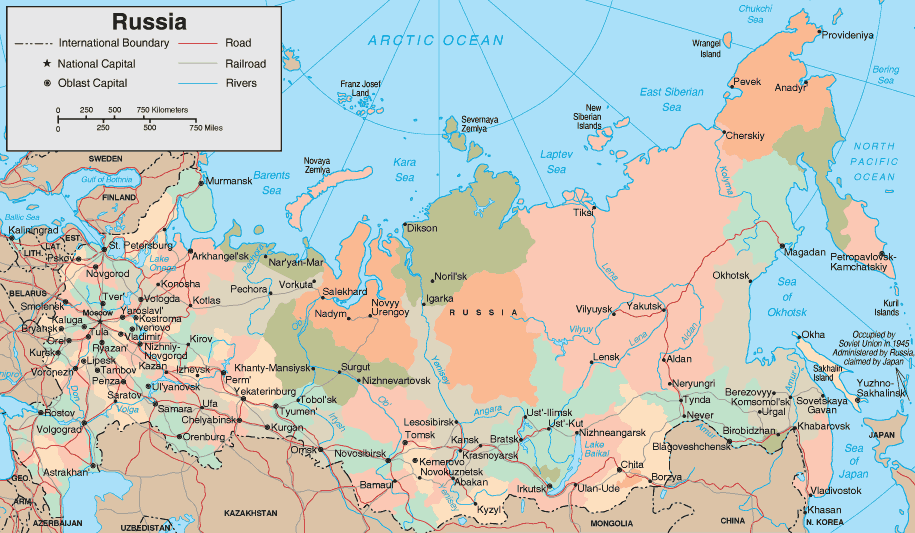
with golden potato nematode in the territories of Petropavlosk,
Kamchatskiy, Vilyuchinsk, Elizovo cities, and Milkovo
village. Quarantine phytosanitary measures will be implemented
by the regional Rosselkhoznadzor administration [Federal Service
for Veterinary and Phytosanitary Surveillance]. Strict control
will be in place in airports, naval ports, and postal offices
where all cargo and parcels will be inspected for potatoes,
potato seed tubers, and seedlings.
--
communicated by:
ProMED-mail
<promed@promedmail.org>
[Both golden (_Globodera rostochiensis_, with at least 5 races)
and pale (_G. pallida_) potato cyst nematodes (PCNs) cause
serious crop losses in potato. They can also infect other
solanaceous crops and weeds, and cysts
containing viable eggs can survive in the soil for up to 20
years. Disease management includes exclusion and crop rotation
with non-host species. Race identification is important for the
use of resistant crop cultivars. Both
PCNs have been included on the alert list of the European Plant
Protection Organisation (EPPO). For more information on these
pathogens please see previous ProMED-mail posts and links below.
While pale PCN has never been reported from Russia and its
immediate neighbours, golden PCN is widely distributed in the
Eurasian area. Previous reports from Russia include Kurgan and
Altai in 2005 (ProMED-mail:
20050809.2322 and 20050707.1921), and recent PCN detections from
other south western regions in July 2008 (Chelyabinsk;
ProMED-mail: 20080714.2138) and in October 2008 (Tomsk;
information by Corr.BA) were also considered likely to be golden
PCN. But this seems to be the 1st report of golden PCN from as
far east in Russia as Kamchatka.
The 3 PCN detections in Russia in 2008 are from locations well
separated by distance and are not likely to be due to recent
spread because these pathogens need 6-7 years to build up
numbers sufficient for detection. It is possible, however, that
the PCNs in the different locations may be due to contaminated
seed potatoes distributed from a central source in the past.
This was reported to have occurred for _Potato spindle tuber
viroid_ strains (ProMED-mail: 20070423.1323), and we would be
most grateful for any further information on possible modes of
spread of golden PCN in Russia.
Maps
Russia:
<http://www.map-of-russia.org/map-of-russia.gif>
and
<http://healthmap.org/promed/en?g=2125073&v=65,135,3>
Russian regions:
<http://map.rin.ru/index_e.html>
Kamchatka Region:
<http://map.rin.ru/cgi-bin/main_e.pl?Region=kamchat>
Worldwide distribution of golden PCN (July 2008):
<http://www.eppo.org/QUARANTINE/nematodes/Globodera_rostochiensis/HETDRO_map.htm>
Worldwide distribution of pale PCN (July 2008):
<http://www.eppo.org/QUARANTINE/nematodes/Globodera_pallida/HETDPA_map.htm>
Pictures
Symptoms of golden nematode on potato plants:
<http://www.dpi.vic.gov.au/CA25677D007DC87D/LUbyDesc/Ag0572a/$File/Ag0572a.jpg>
and
<http://www.nysaes.cornell.edu/ent/bcconf/talks/images/brodie2.gif>
Golden and pale PCN cysts:
<http://www.eppo.org/QUARANTINE/nematodes/Globodera_pallida/HETDSP_images.htm>
Links
Information on _G. rostochiensis_:
<http://www.dpi.vic.gov.au/dpi/nreninf.nsf/childdocs/-71E8091F577D52D24A2568B30004F3B2-07E8C65C31CFC12CCA256BC800029303-4C9C6833948D4DF54A256DEA00274836-386AFCFE1CD9F10ECA256BCF000BBFE4?open>
and
<http://plpnemweb.ucdavis.edu/nemaplex/Taxadata/G053s2.htm>
Information on _G. pallida_:
<http://nematode.unl.edu/pest5.htm>
and
<http://plpnemweb.ucdavis.edu/nemaplex/taxadata/G053S1.HTM>
Data sheets on both potato cyst nematodes:
<http://www.dpi.qld.gov.au/cps/rde/dpi/hs.xsl/4790_12368_ENA_HTML.htm>,
<http://www.eppo.org/QUARANTINE/nematodes/Globodera_pallida/HETDSP_ds.pdf>,
and
<http://www.inspection.gc.ca/english/plaveg/pestrava/gloros/tech/glorose.shtml>
EPPO alert list:
<http://www.eppo.org/QUARANTINE/listA2.htm>.
- Mod.DHA]
[see also
in the
archive:
Cyst nematodes, potato - Russia: (Chelyabinsk) 20080714.2138
2007
---
Potato spindle tuber viroid, potato - Russia: novel strains
20070423.1323
2005
---
Potato cyst nematodes - Russia (Kurgan) 20050809.2322
Potato cyst nematodes, Russia (Altai Region) 20050707.1921]