Australia
February 09
Source:
Australian Oilseeds
Federation (AOF)
 Canola
2008/09 Canola
2008/09
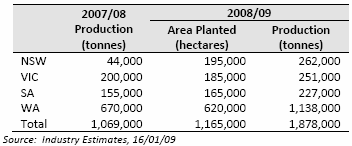
Canola production estimates have been finalised for the 2008/09
season. The crop finished better than expected with the variable
conditions on the east coast not impacting yields as
significantly as expected. The good finish to the Western
Australian crop has seen production revised up also. Overall
production for the national crop has been revised up to 1.88
million tonnes.
Sunflower 2008/09
Harvesting of early planted mono crops has commenced in all
areas except Liverpool Plains. Yields are reported as ranging
between 1.2 to 1.8 tonnes/Ha and early oil results are
indicating 40 to 41%. The effect of the hot dry
conditions across northern NSW and southern Queensland on late
crop yield potential is still to be realised. The
proportion of the crop on irrigation is expected to hold up
average yields. Almost 80% of the crop is mono‐unsaturated type,
with poly around 20% and balance in birdseed/confectionary
types.
 The
Liverpool Plains has experienced very hot and dry conditions for
most of January and February. This has The
Liverpool Plains has experienced very hot and dry conditions for
most of January and February. This has
placed all crops under stress and depleted remaining soil
moistures to critical levels. Rainfall of 30‐50 mm on 14‐15
February was received across most of the region and this will
benefit the crop going forward. The early planted crops are
ranging from mid grain fill through to harvest ready. Current
yield estimates are for the crop to average 2.0 t/ha, with
better crops possibly realising 2.5 t/ha.
Rutherglen bug pressure has been
minimal, although most growers have sprayed at least once for
Rutheglen bug and/or heliothis.
Harvest is now underway in the Moree district for early planted
crops, about two weeks behind usual practice. The
rainfall in mid February will delay harvesting for a further
week. Yields have been variable ranging from 1.2‐2.0 t/ha. Oil
yields are averaging around 38%, but some crops have yielded in
the low 40% range. The late planted crops are varying from
budding through to flowering, with the mid month rainfall
providing a well needed boost to these crops.
Soybean 2008/09
 January
and February have seen a mixed bag for the national soybean
crop, with extremely heavy rainfall in January
and February have seen a mixed bag for the national soybean
crop, with extremely heavy rainfall in
northern Queensland causing flooding and water logging combined
with hot dry conditions in southern Queensland and NSW. Overall,
the national crop prospects are still positive at this stage
although favourable conditions for the remainder of the season
are required to realise potential.
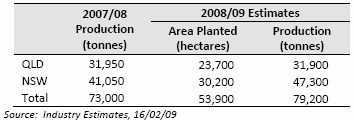
Planting has been finalised in Queensland, with heavy rainfall
in early February preventing the possibility of
further planting reported last month. Overall there are no
changes to last month’s area predictions. The effects of the
heavy rainfall in northern and central Queensland are still to
be determined and it is too early to account for the effect on
potential crop yields. Crops in southern Queensland have
continued to experience stress due to the hot, drier conditions.
This is expected to impact yields in these regions, but the
prospect of rain in mid to late February could counteract this
effect and thus, estimates have been left unchanged at this
stage. The Burnett, Lockyer and Fassifern areas received small
rainfall events in early February which have help to sustain
crop growth and potential. |
